SKU: CT-CSS-0223
Downloads
Specification
Share
CANmod.router: 4 x CAN to 1 x CAN (or USB) Converter/Gateway
Regular price£421.00 Sale price Pricing excludes VAT.Shipping cost calculated in checkout.
Select Title
Availability & delivery
✔ In stock
Stocked item. For higher volumes, please contact us to confirm availability.
🚚 Free UK delivery on orders over £250
Estimated delivery: 1–3 working days after dispatch
Need help choosing?
If you’re unsure which product is right for your project, our in-house team is here to help.
- Message us via the chat bubble (Mon–Fri, 9–5)
- Or give us a call on +44 (0) 1234 247176
| GENERAL | |
|---|---|
| Functionality | The device routes data from four isolated CAN buses (incl. FD) to one primary CAN bus (or USB) |
| Included | CANmod.router module and USB dust cover (DB25-to-4x-DB9 adapter and USB adapter not included) |
| Firmware | Supports free firmware updates via USB for adding features |
| Configuration | Configuration files based on the popular open source JSON schema concept (similar to the CANedge) |
| Software | Free open source editor tool (offline/online version available) Free open source SavvyCAN GUI for streaming of raw / DBC decoded data via USB Free open source Python API for streaming of raw / DBC decoded data via USB |
| Safety | CE, FCC, IC and RoHS certified |
| Warranty | 1-year warranty |
| Support | Free, fast & high quality support |
| Origin | Denmark |
| ROUTER MODES | |
| Mux-Mode | Traffic from/to secondary CAN buses is muxed and transported through 'tunnels' via primary CAN bus Demuxing done via SavvyCAN, USB Python API, MF4 Python API, mdf2mdf |
| CAN BUS (CAN-S) | |
| Channels | 4 x CAN channels (incl. CAN FD support) |
| Isolation | Basic galvanic isolation |
| Standard | ISO 11898 compliant (5K–1 Mbit/s CAN, 1M–5M CAN FD) |
| Protocols | Receive/transmit raw CAN based protocols (J1939, CANopen, NMEA 2000, OBD2, UDS) |
| Identifiers | CAN 2.0A (11-Bit ID) and 2.0B (29-Bit ID) |
| Retransmission | Retransmission of frames that have lost arbitration or been disturbed by errors |
| Transceiver Protection | ±25kV HBM ESD, ±12kV IEC ESD, ±14V bus fault, short circuit Common mode input voltage: ±12V TXD dominant timeout (prevents network blocking in the event of a failure) |
| CAN BUS (CAN-P) | |
| Channels | 1 x CAN channel (incl. CAN FD support) |
| Modes | Broadcast the data onto the CAN bus or provide it on-request |
| Standard | ISO 11898 compliant (5K–1 Mbit/s CAN, 1M–5M CAN FD) |
| Termination | Termination can be toggled via switch below DB9 connector |
| Retransmission | Retransmission of frames that have lost arbitration or been disturbed by errors |
| Transceiver Protection | ±25kV HBM ESD, ±12kV IEC ESD, ±14V bus fault, short circuit Common mode input voltage: ±12V TXD dominant timeout (prevents network blocking in the event of a failure) |
| CONFIG (CAN-S) | |
| Independence | Each secondary CAN channel can be independently configured (router mode set globally) |
| Bit-Rate | Standard bit-rates (5K–1M) or custom bit-timing per channel |
| Bit-Rate Auto-Detect | Bit-rates can be set manually (auto-detection pending firmware) |
| Silent Mode | Restricted (acknowledge only) or monitoring (zero transmission) |
| Filters | 32 regular/extended ID filters per channel (mask, acceptance, rejection) |
| Prescalers | Prescale CAN frames by time (per X ms) or by data changes |
| Transmit | Transmit lists of up to 16 CAN frames per channel (single-shot/periodic). Transmission can also be controlled from the CAN-P interface |
| CAN Error Frames | Support for logging CAN error frames (bit-stuffing, form, CRC, bit, acknowledgement) |
| CONFIG (CAN-P) | |
| Bit-Rate | Standard bit-rates (5K–1M CAN, 1M–4M CAN FD) or custom bit-timing |
| Identifier Customization | Individually configure each CAN ID (11-bit or 29-bit) |
| OTHER | |
| Precision | Cross-channel precision of 1 ms |
| Frames/Second | Mux-mode: Route 6,000+ frames/second (Classical CAN) |
| ELECTRICAL | |
| Input Supply | +5V to +26V DC via the DB9 connector (power via pin 1 or pin 9) or via USB for updating firmware/config or streaming |
| Power Consumption | Extremely low (<1W) |
| Protection | Reverse voltage protection on CAN-bus supply Transient voltage event protection on supply lines |
| MECHANICAL | |
| Enclosure & Weight | Compact aluminium enclosure: 65 x 48 x 24 mm (W x L x H excl. flanges & connectors). 75 grams |
| Connector (Front) | 1 x Standard D-sub 9 (DB9) |
| Connector (Back) | 1 x D-sub 25 (DB25) |
| USB | Standard mini USB connector for configuration, firmware updates and streaming |
| LEDs | 7 external LEDs: Power, CAN-P, Memory, CAN-S1, CAN-S2, CAN-S3, CAN-S4 |
| Temperature | Operating temperature: -25°C to +70°C |
| IP Rating | IP40 |

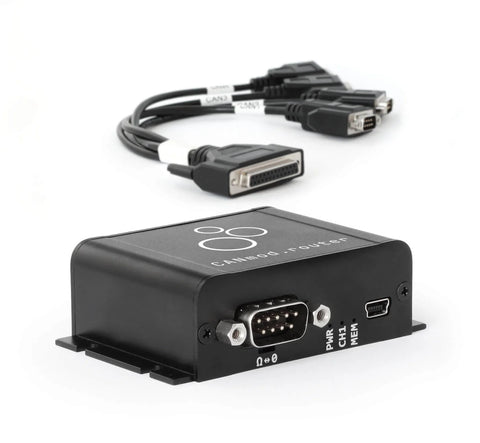
The CANmod.router lets you receive/transmit CAN data (Classical or FD) from/to 4 isolated secondary CAN buses via 1 primary CAN bus (or USB).
The compact module is 100% standalone (no PC required) and offers pro specs, daisy chaining and powerful configuration options.
It can be used with the CANedge, enabling you to log 5 x CAN buses (or 9 x CAN via daisy chaining).
Or, deploy it as a CAN bus gateway to easily merge/split/filter CAN buses (incl. ID re-mapping).
Finally, it can be used as a 4 x CAN FD to USB interface with free software/API tools.
Tip: Add the DB25-to-4x-DB9 for quick installation.
| GENERAL | |
|---|---|
| Functionality | The device routes data from four isolated CAN buses (incl. FD) to one primary CAN bus (or USB) |
| Included | CANmod.router module and USB dust cover (DB25-to-4x-DB9 adapter and USB adapter not included) |
| Firmware | Supports free firmware updates via USB for adding features |
| Configuration | Configuration files based on the popular open source JSON schema concept (similar to the CANedge) |
| Software | Free open source editor tool (offline/online version available) Free open source SavvyCAN GUI for streaming of raw / DBC decoded data via USB Free open source Python API for streaming of raw / DBC decoded data via USB |
| Safety | CE, FCC, IC and RoHS certified |
| Warranty | 1-year warranty |
| Support | Free, fast & high quality support |
| Origin | Denmark |
| ROUTER MODES | |
| Mux-Mode | Traffic from/to secondary CAN buses is muxed and transported through 'tunnels' via primary CAN bus Demuxing done via SavvyCAN, USB Python API, MF4 Python API, mdf2mdf |
| CAN BUS (CAN-S) | |
| Channels | 4 x CAN channels (incl. CAN FD support) |
| Isolation | Basic galvanic isolation |
| Standard | ISO 11898 compliant (5K–1 Mbit/s CAN, 1M–5M CAN FD) |
| Protocols | Receive/transmit raw CAN based protocols (J1939, CANopen, NMEA 2000, OBD2, UDS) |
| Identifiers | CAN 2.0A (11-Bit ID) and 2.0B (29-Bit ID) |
| Retransmission | Retransmission of frames that have lost arbitration or been disturbed by errors |
| Transceiver Protection | ±25kV HBM ESD, ±12kV IEC ESD, ±14V bus fault, short circuit Common mode input voltage: ±12V TXD dominant timeout (prevents network blocking in the event of a failure) |
| CAN BUS (CAN-P) | |
| Channels | 1 x CAN channel (incl. CAN FD support) |
| Modes | Broadcast the data onto the CAN bus or provide it on-request |
| Standard | ISO 11898 compliant (5K–1 Mbit/s CAN, 1M–5M CAN FD) |
| Termination | Termination can be toggled via switch below DB9 connector |
| Retransmission | Retransmission of frames that have lost arbitration or been disturbed by errors |
| Transceiver Protection | ±25kV HBM ESD, ±12kV IEC ESD, ±14V bus fault, short circuit Common mode input voltage: ±12V TXD dominant timeout (prevents network blocking in the event of a failure) |
| CONFIG (CAN-S) | |
| Independence | Each secondary CAN channel can be independently configured (router mode set globally) |
| Bit-Rate | Standard bit-rates (5K–1M) or custom bit-timing per channel |
| Bit-Rate Auto-Detect | Bit-rates can be set manually (auto-detection pending firmware) |
| Silent Mode | Restricted (acknowledge only) or monitoring (zero transmission) |
| Filters | 32 regular/extended ID filters per channel (mask, acceptance, rejection) |
| Prescalers | Prescale CAN frames by time (per X ms) or by data changes |
| Transmit | Transmit lists of up to 16 CAN frames per channel (single-shot/periodic). Transmission can also be controlled from the CAN-P interface |
| CAN Error Frames | Support for logging CAN error frames (bit-stuffing, form, CRC, bit, acknowledgement) |
| CONFIG (CAN-P) | |
| Bit-Rate | Standard bit-rates (5K–1M CAN, 1M–4M CAN FD) or custom bit-timing |
| Identifier Customization | Individually configure each CAN ID (11-bit or 29-bit) |
| OTHER | |
| Precision | Cross-channel precision of 1 ms |
| Frames/Second | Mux-mode: Route 6,000+ frames/second (Classical CAN) |
| ELECTRICAL | |
| Input Supply | +5V to +26V DC via the DB9 connector (power via pin 1 or pin 9) or via USB for updating firmware/config or streaming |
| Power Consumption | Extremely low (<1W) |
| Protection | Reverse voltage protection on CAN-bus supply Transient voltage event protection on supply lines |
| MECHANICAL | |
| Enclosure & Weight | Compact aluminium enclosure: 65 x 48 x 24 mm (W x L x H excl. flanges & connectors). 75 grams |
| Connector (Front) | 1 x Standard D-sub 9 (DB9) |
| Connector (Back) | 1 x D-sub 25 (DB25) |
| USB | Standard mini USB connector for configuration, firmware updates and streaming |
| LEDs | 7 external LEDs: Power, CAN-P, Memory, CAN-S1, CAN-S2, CAN-S3, CAN-S4 |
| Temperature | Operating temperature: -25°C to +70°C |
| IP Rating | IP40 |