CANmod.router: 4 x CAN to 1 x CAN (or USB) Converter/Gateway
Regular price£421.00 Sale price Pricing excludes VAT.Shipping cost calculated in checkout.
Free standard shipping on orders above £250.00
Notice:
Some of our products are on varied lead times, For confirmation on when you can expect your order to arrive, please call in and speak to one of our experts.
Our team are available from 9:00am - 5:00pm on +44(0) 1234 247 176 and will be happy to discuss any questions.
Queries and Shipping
If you’re unsure which product is right for your project, our team is here to help.
Use the chat bubble below, or call us 9am-5pm on +44 (0) 1234 247176 for advice.
Shipping: Some products have varied lead times. For exact delivery estimates and shipping costs, add the item to your basket and proceed to checkout, or call our team for confirmation.
| GENERAL | |
|---|---|
| Functionality | The device routes data from four isolated CAN buses (incl. FD) to one primary CAN bus (or USB) |
| Included | CANmod.router module and USB dust cover (DB25-to-4x-DB9 adapter and USB adapter not included) |
| Firmware | Supports free firmware updates via USB for adding features |
| Configuration | Configuration files based on the popular open source JSON schema concept (similar to the CANedge) |
| Software | Free open source editor tool (offline/online version available) Free open source SavvyCAN GUI for streaming of raw / DBC decoded data via USB Free open source Python API for streaming of raw / DBC decoded data via USB |
| Safety | CE, FCC, IC and RoHS certified |
| Warranty | 1-year warranty |
| Support | Free, fast & high quality support |
| Origin | Denmark |
| ROUTER MODES | |
| Mux-Mode | Traffic from/to secondary CAN buses is muxed and transported through 'tunnels' via primary CAN bus Demuxing done via SavvyCAN, USB Python API, MF4 Python API, mdf2mdf |
| CAN BUS (CAN-S) | |
| Channels | 4 x CAN channels (incl. CAN FD support) |
| Isolation | Basic galvanic isolation |
| Standard | ISO 11898 compliant (5K–1 Mbit/s CAN, 1M–5M CAN FD) |
| Protocols | Receive/transmit raw CAN based protocols (J1939, CANopen, NMEA 2000, OBD2, UDS) |
| Identifiers | CAN 2.0A (11-Bit ID) and 2.0B (29-Bit ID) |
| Retransmission | Retransmission of frames that have lost arbitration or been disturbed by errors |
| Transceiver Protection | ±25kV HBM ESD, ±12kV IEC ESD, ±14V bus fault, short circuit Common mode input voltage: ±12V TXD dominant timeout (prevents network blocking in the event of a failure) |
| CAN BUS (CAN-P) | |
| Channels | 1 x CAN channel (incl. CAN FD support) |
| Modes | Broadcast the data onto the CAN bus or provide it on-request |
| Standard | ISO 11898 compliant (5K–1 Mbit/s CAN, 1M–5M CAN FD) |
| Termination | Termination can be toggled via switch below DB9 connector |
| Retransmission | Retransmission of frames that have lost arbitration or been disturbed by errors |
| Transceiver Protection | ±25kV HBM ESD, ±12kV IEC ESD, ±14V bus fault, short circuit Common mode input voltage: ±12V TXD dominant timeout (prevents network blocking in the event of a failure) |
| CONFIG (CAN-S) | |
| Independence | Each secondary CAN channel can be independently configured (router mode set globally) |
| Bit-Rate | Standard bit-rates (5K–1M) or custom bit-timing per channel |
| Bit-Rate Auto-Detect | Bit-rates can be set manually (auto-detection pending firmware) |
| Silent Mode | Restricted (acknowledge only) or monitoring (zero transmission) |
| Filters | 32 regular/extended ID filters per channel (mask, acceptance, rejection) |
| Prescalers | Prescale CAN frames by time (per X ms) or by data changes |
| Transmit | Transmit lists of up to 16 CAN frames per channel (single-shot/periodic). Transmission can also be controlled from the CAN-P interface |
| CAN Error Frames | Support for logging CAN error frames (bit-stuffing, form, CRC, bit, acknowledgement) |
| CONFIG (CAN-P) | |
| Bit-Rate | Standard bit-rates (5K–1M CAN, 1M–4M CAN FD) or custom bit-timing |
| Identifier Customization | Individually configure each CAN ID (11-bit or 29-bit) |
| OTHER | |
| Precision | Cross-channel precision of 1 ms |
| Frames/Second | Mux-mode: Route 6,000+ frames/second (Classical CAN) |
| ELECTRICAL | |
| Input Supply | +5V to +26V DC via the DB9 connector (power via pin 1 or pin 9) or via USB for updating firmware/config or streaming |
| Power Consumption | Extremely low (<1W) |
| Protection | Reverse voltage protection on CAN-bus supply Transient voltage event protection on supply lines |
| MECHANICAL | |
| Enclosure & Weight | Compact aluminium enclosure: 65 x 48 x 24 mm (W x L x H excl. flanges & connectors). 75 grams |
| Connector (Front) | 1 x Standard D-sub 9 (DB9) |
| Connector (Back) | 1 x D-sub 25 (DB25) |
| USB | Standard mini USB connector for configuration, firmware updates and streaming |
| LEDs | 7 external LEDs: Power, CAN-P, Memory, CAN-S1, CAN-S2, CAN-S3, CAN-S4 |
| Temperature | Operating temperature: -25°C to +70°C |
| IP Rating | IP40 |

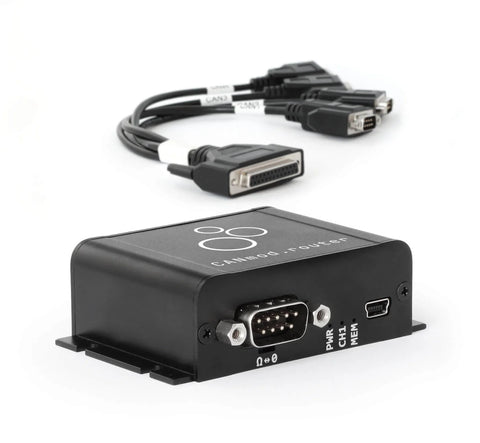
The CANmod.router lets you receive/transmit CAN data (Classical or FD) from/to 4 isolated secondary CAN buses via 1 primary CAN bus (or USB).
The compact module is 100% standalone (no PC required) and offers pro specs, daisy chaining and powerful configuration options.
It can be used with the CANedge, enabling you to log 5 x CAN buses (or 9 x CAN via daisy chaining).
Or, deploy it as a CAN bus gateway to easily merge/split/filter CAN buses (incl. ID re-mapping).
Finally, it can be used as a 4 x CAN FD to USB interface with free software/API tools.
Tip: Add the DB25-to-4x-DB9 for quick installation.
| GENERAL | |
|---|---|
| Functionality | The device routes data from four isolated CAN buses (incl. FD) to one primary CAN bus (or USB) |
| Included | CANmod.router module and USB dust cover (DB25-to-4x-DB9 adapter and USB adapter not included) |
| Firmware | Supports free firmware updates via USB for adding features |
| Configuration | Configuration files based on the popular open source JSON schema concept (similar to the CANedge) |
| Software | Free open source editor tool (offline/online version available) Free open source SavvyCAN GUI for streaming of raw / DBC decoded data via USB Free open source Python API for streaming of raw / DBC decoded data via USB |
| Safety | CE, FCC, IC and RoHS certified |
| Warranty | 1-year warranty |
| Support | Free, fast & high quality support |
| Origin | Denmark |
| ROUTER MODES | |
| Mux-Mode | Traffic from/to secondary CAN buses is muxed and transported through 'tunnels' via primary CAN bus Demuxing done via SavvyCAN, USB Python API, MF4 Python API, mdf2mdf |
| CAN BUS (CAN-S) | |
| Channels | 4 x CAN channels (incl. CAN FD support) |
| Isolation | Basic galvanic isolation |
| Standard | ISO 11898 compliant (5K–1 Mbit/s CAN, 1M–5M CAN FD) |
| Protocols | Receive/transmit raw CAN based protocols (J1939, CANopen, NMEA 2000, OBD2, UDS) |
| Identifiers | CAN 2.0A (11-Bit ID) and 2.0B (29-Bit ID) |
| Retransmission | Retransmission of frames that have lost arbitration or been disturbed by errors |
| Transceiver Protection | ±25kV HBM ESD, ±12kV IEC ESD, ±14V bus fault, short circuit Common mode input voltage: ±12V TXD dominant timeout (prevents network blocking in the event of a failure) |
| CAN BUS (CAN-P) | |
| Channels | 1 x CAN channel (incl. CAN FD support) |
| Modes | Broadcast the data onto the CAN bus or provide it on-request |
| Standard | ISO 11898 compliant (5K–1 Mbit/s CAN, 1M–5M CAN FD) |
| Termination | Termination can be toggled via switch below DB9 connector |
| Retransmission | Retransmission of frames that have lost arbitration or been disturbed by errors |
| Transceiver Protection | ±25kV HBM ESD, ±12kV IEC ESD, ±14V bus fault, short circuit Common mode input voltage: ±12V TXD dominant timeout (prevents network blocking in the event of a failure) |
| CONFIG (CAN-S) | |
| Independence | Each secondary CAN channel can be independently configured (router mode set globally) |
| Bit-Rate | Standard bit-rates (5K–1M) or custom bit-timing per channel |
| Bit-Rate Auto-Detect | Bit-rates can be set manually (auto-detection pending firmware) |
| Silent Mode | Restricted (acknowledge only) or monitoring (zero transmission) |
| Filters | 32 regular/extended ID filters per channel (mask, acceptance, rejection) |
| Prescalers | Prescale CAN frames by time (per X ms) or by data changes |
| Transmit | Transmit lists of up to 16 CAN frames per channel (single-shot/periodic). Transmission can also be controlled from the CAN-P interface |
| CAN Error Frames | Support for logging CAN error frames (bit-stuffing, form, CRC, bit, acknowledgement) |
| CONFIG (CAN-P) | |
| Bit-Rate | Standard bit-rates (5K–1M CAN, 1M–4M CAN FD) or custom bit-timing |
| Identifier Customization | Individually configure each CAN ID (11-bit or 29-bit) |
| OTHER | |
| Precision | Cross-channel precision of 1 ms |
| Frames/Second | Mux-mode: Route 6,000+ frames/second (Classical CAN) |
| ELECTRICAL | |
| Input Supply | +5V to +26V DC via the DB9 connector (power via pin 1 or pin 9) or via USB for updating firmware/config or streaming |
| Power Consumption | Extremely low (<1W) |
| Protection | Reverse voltage protection on CAN-bus supply Transient voltage event protection on supply lines |
| MECHANICAL | |
| Enclosure & Weight | Compact aluminium enclosure: 65 x 48 x 24 mm (W x L x H excl. flanges & connectors). 75 grams |
| Connector (Front) | 1 x Standard D-sub 9 (DB9) |
| Connector (Back) | 1 x D-sub 25 (DB25) |
| USB | Standard mini USB connector for configuration, firmware updates and streaming |
| LEDs | 7 external LEDs: Power, CAN-P, Memory, CAN-S1, CAN-S2, CAN-S3, CAN-S4 |
| Temperature | Operating temperature: -25°C to +70°C |
| IP Rating | IP40 |