SKU: CT-CSS-0117
Specification
Share
CANmod.temp: 4 x Thermocouple-to-CAN Temperature Sensor (excl.probes)
Regular price£401.50 Sale price Pricing excludes VAT.Shipping cost calculated in checkout.
Select Title
Availability & delivery
✔ Available to order
Supplied to order from the manufacturer. Please contact us to confirm delivery lead time before placing your order.
🚚 Free UK delivery on orders over £250
Need help choosing?
If you’re unsure which product is right for your project, our in-house team is here to help.
- Message us via the chat bubble (Mon–Fri, 9–5)
- Or give us a call on +44 (0) 1234 247176
The CANmod.temp Specification
| GENERAL | |
|---|---|
| Functionality | The device supports 4 x thermocouples for outputting temperature sensor data via CAN bus |
| Included | CANmod.temp module, USB dust cover (thermocouple sensors and mini USB adapter not included) |
| Firmware | Supports free firmware updates via USB for adding features |
| Configuration | Configuration files based on the popular open source JSON schema concept (similar to the CANedge) |
| Software | Free open source editor tool for easy device configuration (offline/online version available) |
| Safety | CE, FCC, IC and RoHS certified (see the Docs for certificates) |
| Warranty | 1-year warranty |
| Support | Free, fast & high quality support |
| Origin | Denmark |
| SENSOR (temperature) | |
| Channels | Supports up to 4 thermocouple sensors/channels (plus ambient temperature via cold-junction) |
| Module | Professional-grade MAX31856MUD+ precision thermocouple converter |
| Temperature Range | Supports a range of -210°C to +1800°C (depending on thermocouple type) |
| Formatting | The module conveniently outputs degrees celsius via automated edge linearization |
| Accuracy | Lab-grade thermocouple voltage measurement accuracy with cold junction compensation |
| Resolution | 1 degC resolution (in 1 CAN frame) and/or 0.01 degC resolution (in 2 CAN frames) |
| Note: The 0.01 degC resolution typically exceeds the practical probe accuracy | |
| Protection | Thermocouple inputs are protected against overvoltage conditions up to ±45V |
| Types | Supports thermocouple types B, E, J, K, N, R, S, T (via configuration) |
| Filtering | Line frequency filtering of 50Hz and 60Hz (via configuration) |
| Fault Detection | Thermocouple fault detection (open thermocouples, over- and undertemperature) is communicated via CAN |
| Cold Junction | ±0.7°C (max, -20°C to +85°C) cold-junction accuracy |
| DATA PARAMETERS | |
| CAN Signals | The module communicates temperatures and fault statuses (for a full list, see the Docs or DBC file) |
| Thermocouple temperatures: The degree celsius (degC) temperature of each thermocouple probe [5 Hz] | |
| Ambient temperature: The ambient temperature measured via internal cold-junction [5 Hz] | |
| Faults: Status of each thermocouple sensor [5 Hz] | |
| CAN BUS | |
| Channels | 1 x CAN channel |
| Modes | The device can either broadcast the data onto the CAN bus - or provide it on-request |
| Standard | ISO 11898: Compliant with CAN (between 5K and 1 Mbit/s baud rates) |
| Identifiers | Compliant with CAN specifications 2.0A (11-Bit ID) and 2.0B (29-Bit ID) |
| Termination | Termination can be toggled via switch below DB9 connector |
| Retransmission | Retransmission of frames that have lost arbitration or been disturbed by errors |
| Transceiver Protection | Protection: +/- 25kV HBM ESD, +/-12kV IEC ESD, +/-14 V bus fault, short circuit |
| Common mode input voltage: +/-12V | |
| TXD dominant timeout (prevents network blocking in the event of a failure) | |
| CONFIGURATION | |
| Bit Rate | Select between standard bit rates (5K to 1M) or use custom bit-timing |
| Enable/Disable | Individually enable/disable the CAN message |
| Identifier Customization | Individually configure the CAN ID (11-bit or 29-bit) |
| Push/Poll Mode | Individually configure 'trigger' modes for the CAN messages (push or poll) |
| Frequency | Individually configure prescaling of the CAN message frequencies to lower rates |
| Thermocouple Type | Specify the thermocouple type for each channel (e.g. Type K, Type J, ...) |
| Line Noise Filtering | Select rejection of 50 Hz (EU) and its harmonics or 60 Hz (USA) and its harmonics |
| ELECTRICAL | |
| Input Supply | +5V to +26V DC via the DB9 connector (power via pin 1 or pin 9) |
| Power Consumption | Extremely low (<1W) - no risk of battery drainage |
| Protection | Reverse voltage protection on CAN-bus supply |
| Transient voltage event protection on supply lines | |
| MECHANICAL | |
| Enclosure & Weight | Compact aluminium enclosure: 52.5 x 70.0 x 24.5 mm (L x W x H), 80 grams |
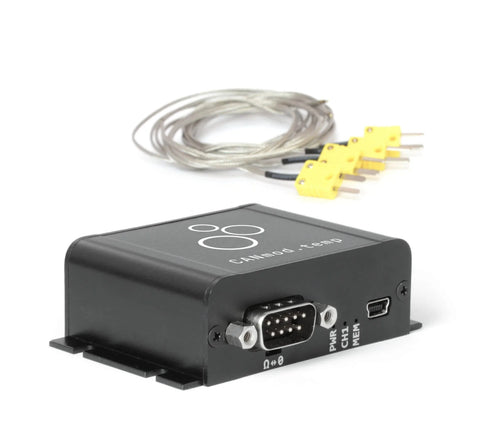
| Connector (Front) | 1 x Standard D-sub 9 (DB9) connector |
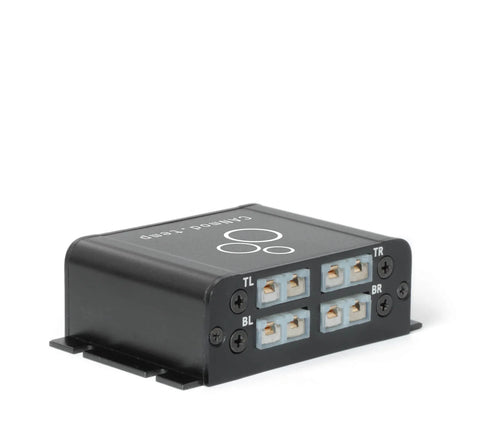
| Connector (Back) | 4 x miniature thermocouple female connectors |
| Pin-Out | See the product manual for the DB9 connector pin-outs |
| USB | Standard mini USB connector for config/firmware updates and streaming (USB cable not included) |
| LEDs | Module status via 3 external LEDs: Power, CAN bus, Memory |
| Temperature | Operating temperature (CANmod.temp module): -25degC to +70degC |
| IP Rating | IP Rating 40 |
| Mounting | Module can be mounted via e.g. rugged double-sided tape, zip-ties or a mounting bracket |

This thermocouple-to-CAN module produces temperature data from 4 thermocouple sensors and outputs it via CAN bus. The module is 100% standalone - no PC required.
The thermocouple to can bus module supports all thermocouple types (B, E, J, K, N, R, S, T) and can be daisy-chained for 8, 12, 16, ... channels.
Explore our I/O modules.
You can integrate the module with any CAN bus system - e.g. to provide temperature data for your ECUs or existing CAN hardware.
As an example, you can use the module as an add-on for the CANedge - ideal for e.g. engine dynos, EGT analysis, HVAC monitoring and other temperature telematics use cases.
The CANmod.temp Specification
| GENERAL | |
|---|---|
| Functionality | The device supports 4 x thermocouples for outputting temperature sensor data via CAN bus |
| Included | CANmod.temp module, USB dust cover (thermocouple sensors and mini USB adapter not included) |
| Firmware | Supports free firmware updates via USB for adding features |
| Configuration | Configuration files based on the popular open source JSON schema concept (similar to the CANedge) |
| Software | Free open source editor tool for easy device configuration (offline/online version available) |
| Safety | CE, FCC, IC and RoHS certified (see the Docs for certificates) |
| Warranty | 1-year warranty |
| Support | Free, fast & high quality support |
| Origin | Denmark |
| SENSOR (temperature) | |
| Channels | Supports up to 4 thermocouple sensors/channels (plus ambient temperature via cold-junction) |
| Module | Professional-grade MAX31856MUD+ precision thermocouple converter |
| Temperature Range | Supports a range of -210°C to +1800°C (depending on thermocouple type) |
| Formatting | The module conveniently outputs degrees celsius via automated edge linearization |
| Accuracy | Lab-grade thermocouple voltage measurement accuracy with cold junction compensation |
| Resolution | 1 degC resolution (in 1 CAN frame) and/or 0.01 degC resolution (in 2 CAN frames) |
| Note: The 0.01 degC resolution typically exceeds the practical probe accuracy | |
| Protection | Thermocouple inputs are protected against overvoltage conditions up to ±45V |
| Types | Supports thermocouple types B, E, J, K, N, R, S, T (via configuration) |
| Filtering | Line frequency filtering of 50Hz and 60Hz (via configuration) |
| Fault Detection | Thermocouple fault detection (open thermocouples, over- and undertemperature) is communicated via CAN |
| Cold Junction | ±0.7°C (max, -20°C to +85°C) cold-junction accuracy |
| DATA PARAMETERS | |
| CAN Signals | The module communicates temperatures and fault statuses (for a full list, see the Docs or DBC file) |
| Thermocouple temperatures: The degree celsius (degC) temperature of each thermocouple probe [5 Hz] | |
| Ambient temperature: The ambient temperature measured via internal cold-junction [5 Hz] | |
| Faults: Status of each thermocouple sensor [5 Hz] | |
| CAN BUS | |
| Channels | 1 x CAN channel |
| Modes | The device can either broadcast the data onto the CAN bus - or provide it on-request |
| Standard | ISO 11898: Compliant with CAN (between 5K and 1 Mbit/s baud rates) |
| Identifiers | Compliant with CAN specifications 2.0A (11-Bit ID) and 2.0B (29-Bit ID) |
| Termination | Termination can be toggled via switch below DB9 connector |
| Retransmission | Retransmission of frames that have lost arbitration or been disturbed by errors |
| Transceiver Protection | Protection: +/- 25kV HBM ESD, +/-12kV IEC ESD, +/-14 V bus fault, short circuit |
| Common mode input voltage: +/-12V | |
| TXD dominant timeout (prevents network blocking in the event of a failure) | |
| CONFIGURATION | |
| Bit Rate | Select between standard bit rates (5K to 1M) or use custom bit-timing |
| Enable/Disable | Individually enable/disable the CAN message |
| Identifier Customization | Individually configure the CAN ID (11-bit or 29-bit) |
| Push/Poll Mode | Individually configure 'trigger' modes for the CAN messages (push or poll) |
| Frequency | Individually configure prescaling of the CAN message frequencies to lower rates |
| Thermocouple Type | Specify the thermocouple type for each channel (e.g. Type K, Type J, ...) |
| Line Noise Filtering | Select rejection of 50 Hz (EU) and its harmonics or 60 Hz (USA) and its harmonics |
| ELECTRICAL | |
| Input Supply | +5V to +26V DC via the DB9 connector (power via pin 1 or pin 9) |
| Power Consumption | Extremely low (<1W) - no risk of battery drainage |
| Protection | Reverse voltage protection on CAN-bus supply |
| Transient voltage event protection on supply lines | |
| MECHANICAL | |
| Enclosure & Weight | Compact aluminium enclosure: 52.5 x 70.0 x 24.5 mm (L x W x H), 80 grams |
| Connector (Front) | 1 x Standard D-sub 9 (DB9) connector |
| Connector (Back) | 4 x miniature thermocouple female connectors |
| Pin-Out | See the product manual for the DB9 connector pin-outs |
| USB | Standard mini USB connector for config/firmware updates and streaming (USB cable not included) |
| LEDs | Module status via 3 external LEDs: Power, CAN bus, Memory |
| Temperature | Operating temperature (CANmod.temp module): -25degC to +70degC |
| IP Rating | IP Rating 40 |
| Mounting | Module can be mounted via e.g. rugged double-sided tape, zip-ties or a mounting bracket |